Notes on Neurons
Preparing for a deeper dive into Neuroscience
(Context: I thought I should practice effectively learning something that's both difficult and useful, just to prove to myself I can. I have a textbook "Neuronal Dynamics" that I had sitting around for a while now, but while it seems promising, I'm immediately faced with a lot of terms I'm not familiar with. Rather than set a goal to finish the first chapter of the textbook and drive myself into the mud, I figured it was more effect to review the basics of neurons first. The secondary goal is to produce a glossary of terms that I can easily lookup in the future as I continue to read the textbook. This is that review/glossary)
Sources: Crash Course The Nervous Systems Parts 1-3
Nervous System
All machines/computers/systems/processes can be understood fundamentally as Input -> Process -> Output
In the human body, we have Sensory Input -> Brain -> Motor Output
Taxonomy:
Central nervous system (Process)
Brain and spine
Peripheral nervous system
Sensory division (Input)
Motor division (Output)
Autonomic nervous system (Short feedback loop)
Somatic nervous system (Long feedback loop)
Ultimately, not very in the context of "Neuronal Dynamics", which seems to be focused exclusively on the neuron, but I thought it was cool the nervous system could be broken down into these fundamental roles
Neurons
Input -> Process -> Output
Dendrite -> Soma -> Axon
There are multiple types of neurons (and other cells in nervous tissue), but we'll be focusing on the most general type of neuron, the multipolar neuron (multiple dendrites + 1 axon)
We can visualise the neuron abstractly as a kind of chicken claw; three pointy bits (dendrites), a center bit where they join (soma), and a straight bit (axon)
Neurons can be imagined as a fleshy battery, membrane separates insides and outsides, maintaining electric potential difference (membrane potential)
Membrane potential is from different concentrations of sodium and potassium ions inside and outside the neuron
Suppose we have a resting neuron, membrane potential is -70 mVs (there are more positive sodium ions outside the neuron than positive potassium ions inside the neuron, resulting in the potential difference)
Neuron has several mechanisms to depolarise (decrease membrane potential) and repolarise (increase membrane potential). Signals are sent between neurons when membrane potential crosses a threshold of -55 mVs
Neuron has ion channels and pumps
Channels can be ligand-gated (by neurotransmitter), voltage-gated (the the threshold for activation), and mechanically-gated (no idea how this works)
When channels are open, ions flow diffuse through the membrane due to disequilibrium ``
Pumps go the opposite direction, from equilibrium to disequilibrium
Suppose a spider jumps on your leg, sodium ligand-gated channels are opened by a neurotransmitter, sodium ions flow into the neuron, decreasing membrane potential
Sodium voltage-gated channels open when they reach the threshold membrane potential, more sodium ions flow in
The potential difference "moves through" the neuron (action potential)
So many sodium ions flow in there is a temporary positive potential difference (depolarisation)
Potassium voltage-gated channels open, potassium ions flow out of the neuron (repolarisation)
So many potassium ions flow out that membrane potential temporarily drops to < -70 mVs (hyperpolarisation)
The sodium-potassium pump moves three sodium out for every two potassium in, and the membrane potential is restored to -70 mVs
While all of this is happening, neuron is unable to receive any new signals, refractory period (I'm not sure if it's strictly physically impossible, and if so why, but I don't want to go too deep at this stage)
The electrical signal is of constant strength, what differs is the frequency of the signal (and arrangement of the neuron, I guess)
Synapses
Electrical potential has arrived at the end of the axon (synapse seems to be more the location of the juncture between two neurons than a specific thing)
(Note than the axon of one neuron can be connected to like 1,000 other neurons, so the transmission is actually complex)
Neuron which is transmitting is presynaptic neuron, receiving is postsynaptic neuron
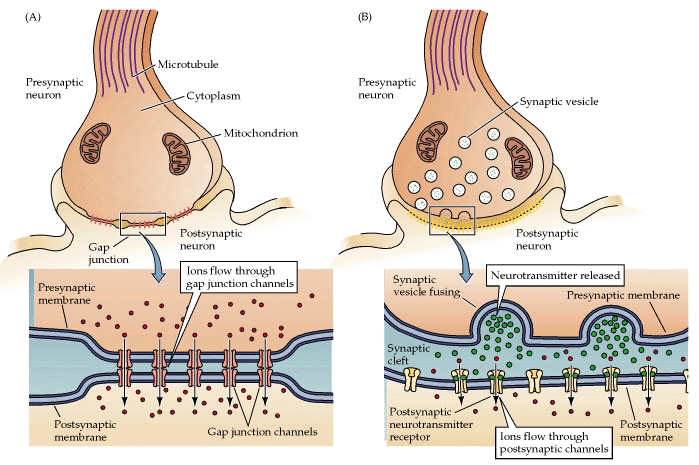
Synapses can be electrical or chemical
Electrical - Fast, coordinated, "group text", e.g. heart muscles, ions flow through gap junctions
Chemical - Slow, moderated, "direct message", action potential activates calcium voltage-gated channels open, calcium ions flow in, synaptic vesicles fuse with cell membrane and release neurotransmitters, which diffuse across synaptic cleft, binding to receptors on post-synaptic neurons